Best AI Models in 2026: Which to Use for Every Task
Skillpedia team · updated 2026-10-16 · 14 min read
Short answer: There is no single best AI model. The right choice depends entirely on the task you need to do and your budget. In 2026, we have amazing options for coding, writing, analyzing, or automating, each with its own strength.
Choosing an artificial intelligence model today can seem complicated. There are so many names: Claude, GPT, Gemini... And each one promises to be the best. The truth is the landscape evolves fast, and luckily, in 2026 we have clarity about who does what best. This article will guide you, simply, through the best AI models available, explaining which to use for coding, creating long texts, high-volume tasks, or building autonomous agents. Let's leave the jargon aside and focus on what matters: helping you make the best decision.
Table of Contents
- There is no one-size-fits-all model
- What is an AI model, anyway?
- Main models in October 2026
- Who leads the independent rankings?
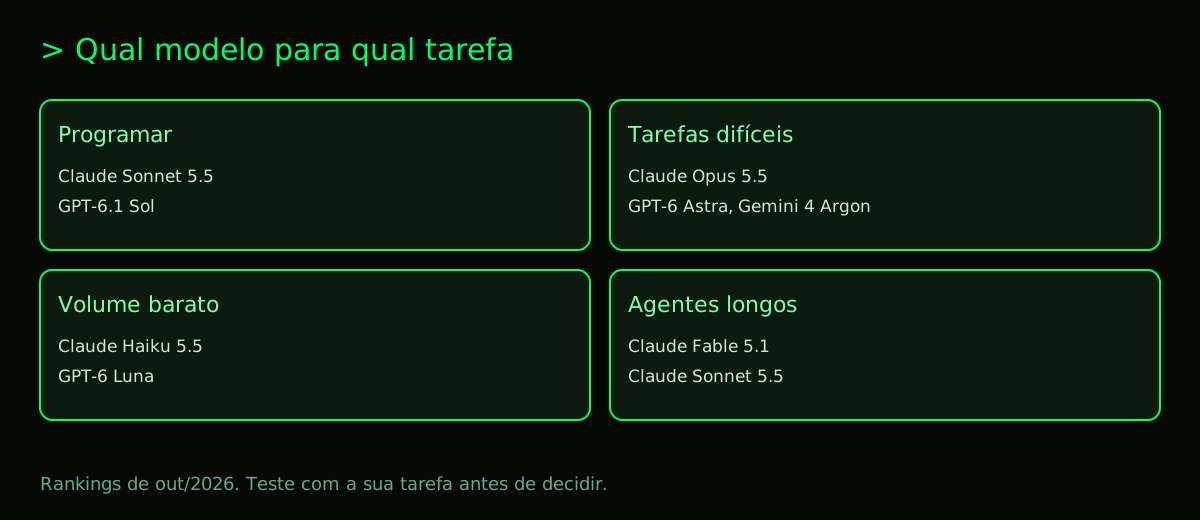
- Best AI model for coding
- Best AI model for writing texts
- Best for cheap, high-volume tasks
- Best for building autonomous agents
- Large models vs. small models
- The open source and local world
- How to choose your model in 4 questions
- How to test multiple models at once
- Important warning: everything changes very fast
- We recommend testing these 3 skills first
- Frequently asked questions
There is no one-size-fits-all model
Asking "what is the best AI model" is like asking "what is the best vehicle." It depends! If you need to go to the bakery, a bicycle is perfect. If you're traveling with family, a car is better. If you need to transport tons of cargo, then it's a truck.
With AI, it's the same thing. The most powerful and expensive model can be overkill for simple tasks. And the cheapest model may not have the capacity for a complex project. The smart choice in 2026 always takes two factors into account: the task and the cost.
What is an AI model, anyway?
Let's simplify. Think of ChatGPT, Claude.ai, or the Gemini app you use. These are the applications, the interface, the store where you shop.
The AI model is the brain behind the application. It's the engine, the intelligence itself. For example, when you use ChatGPT, the app is communicating with a model like GPT-6 Astra or GPT-6.1 Sol. When you use Claude, you're talking to Claude Opus or Claude Haiku.
Understanding this difference is crucial because today many apps allow you to choose which "brain" to use for each conversation or task. You're no longer stuck with just one.
Main models in October 2026
The market has consolidated around a few large companies, each with a family of models. Let's look at the main players and their prices. Remember: prices are per million tokens (a unit of text). To learn more about tokens, see our guide What are tokens in AI (and why they run out so fast).
Anthropic (Claude)
Anthropic is known for robust, safe models, great for complex tasks.
- Claude Opus 5.5: The model for the daily grind of difficult tasks, like programming with agents and professional work.
- Claude Sonnet 5.5: The perfect balance between capability and cost.
- Claude Haiku 5.5: The fastest and cheapest for simple tasks.
- Claude Fable 5.1: The most advanced (and most expensive) from Anthropic, designed for agents that work for a long time.
OpenAI (GPT)
OpenAI popularized LLMs and continues to innovate with a wide range.
- GPT-6 Astra: OpenAI's most capable model, a direct competitor to Opus.
- GPT-6.1 Sol: Offers performance close to Astra for a fraction of the price.
- GPT-6 Luna: An affordable and fast model, available even in free plans.
Google (Gemini)
Google has deeply integrated its models into its products and Search.
- Gemini 4 Argon: Google's most advanced model, available to everyone since 10/13/2026. According to Google, it's #1 on the Vals Index, which measures tasks in areas like finance, law, and programming.
Other Players
The ecosystem is rich and also includes models like Meta Muse Wonder, xAI Grok 4.7, Mistral Large 4 (in preview), and DeepSeek V4.1 Flash. Some of these, like DeepSeek's, have versions you can download and run on your own.
Price table per million tokens (Oct/2026)
Here is an objective summary of API costs for you to compare. Prices are divided into input (the text you send) and output (the text the model generates).
| Model (Company) | Input Price (US$) | Output Price (US$) |
|---|---|---|
| Claude Opus 5.5 (Anthropic) | 4 | 20 |
| Claude Sonnet 5.5 (Anthropic) | 2 | 10 |
| Claude Haiku 5.5 (Anthropic) | from 0.10 | from 0.50 |
| Claude Fable 5.1 (Anthropic) | 10 | 50 |
| GPT-6 Astra (OpenAI) | 10 | 50 |
| GPT-6.1 Sol (OpenAI) | 2 | 10 |
| GPT-6 Luna (OpenAI) | 0.10 | 0.50 |
| Gemini 4 Argon (Google) | 2* | 10* |
*Promotional price for Gemini 4 Argon on Google's API, valid until 11/30/2026. From 12/01/2026, it becomes US$4 input and US$20 output.
Who leads the independent rankings?
Beyond company announcements, independent organizations evaluate models neutrally. In October 2026, the main rankings showed:
- Overall leader: Claude Opus 5.5 leads the Artificial Analysis Intelligence Index, with 57.6 points (10/15/2026).
- Coding leader: Claude Sonnet 5.5 leads the Vibe Code Bench from Vals.ai, with 92.4%.
- Math leader: GPT-6.1 Sol stands out in mathematical reasoning tasks.
- "Work value" leader: Gemini 4 Argon leads the category that measures performance in professional tasks.
To keep up with these changes, check out our AI Model Rankings.
Best AI model for coding
For developers, the choice is clear. Claude Sonnet 5.5 is the current champion in code benchmarks. It combines excellent code understanding, reasoning capability, and a cost that isn't scary for daily use.
The experience gets even better when you use Claude Code, Anthropic's command line tool. It's included in all paid Claude plans (Pro, Max, Team, Enterprise) and turns your terminal into a programming partner. Installation is simple, whether on macOS, Linux, or Windows. You can learn all about it in the guide Claude Code: what it is, how to download, install, and how much it costs (2026 guide).
Of course, GPT-6.1 Sol is also a great option, especially if you're already in the OpenAI ecosystem. For a deeper dive, we have a dedicated post: Best AI for Coding.
Best AI model for writing texts
Need to create blog articles, scripts, persuasive emails, or complex reports? For long and complex texts, it's worth starting with the large models, like Claude Opus 5.5, GPT-6 Astra, or Gemini 4 Argon. They handle huge contexts well (up to about 1 million tokens) and style instructions. The safest way to choose is to test the same request in all three and compare.
If budget is a concern, intermediate models like GPT-6.1 Sol and Claude Sonnet 5.5 cost much less and handle most daily texts. For shorter, faster tasks like summaries or translations, Claude Haiku 5.5 solves it instantly and for pennies.
We have a complete article analyzing the best tools for writing: Best AI for Writing Texts.
Best for cheap, high-volume tasks
If your need is to process thousands of documents, classify data, extract information, or moderate content on a massive scale, cost per task is king.
In this scenario, small, fast models shine. Claude Haiku 5.5 and GPT-6 Luna are the stars. With prices starting at US$0.10 and US$0.50 per million tokens (input/output), they allow you to automate huge workflows without breaking the bank.
The key is: use the simplest model that can perform the task with the accuracy you need. Often, to extract a phone number from text or classify an email as "urgent" or "normal," you don't need the most expensive brain.
Best for building autonomous agents
AI agents are programs that use an AI model to make decisions, use tools, and perform complex workflows on their own. For this, you need a model with long-range reasoning and reliability.
Claude Fable 5.1 was specifically designed for this purpose, being the most advanced for long-duration agents. For most projects, however, Claude Sonnet 5.5 offers the ideal combination of intelligence, reliability, and cost to make your agent work.
The modern architecture for agents involves MCP (Model Context Protocol), an open standard that works like a "USB-C port for AI apps." It allows you to connect your agent to data, tools, and other systems in a standardized way. Understand more in What is MCP (Model Context Protocol): explained the easy way.
Want to create your own agent? Start with the guide AI Agent: what it is, how it works, and how to create yours (without coding).
Large models vs. small models
Within the same company, the strategy is to offer a family of models. Choosing between them is an exercise in balance.
- Opus vs. Haiku (Anthropic): Opus is the philosopher, the expert who solves deep problems and writes masterfully. Haiku is the fast messenger, delivering instant answers to direct questions. Use Opus for strategy and creation. Use Haiku for queries and automations.
- Astra vs. Luna (OpenAI): The same logic applies. Astra is the flagship model, for when absolute performance is necessary. Luna is the efficient workhorse, for scaling operations.
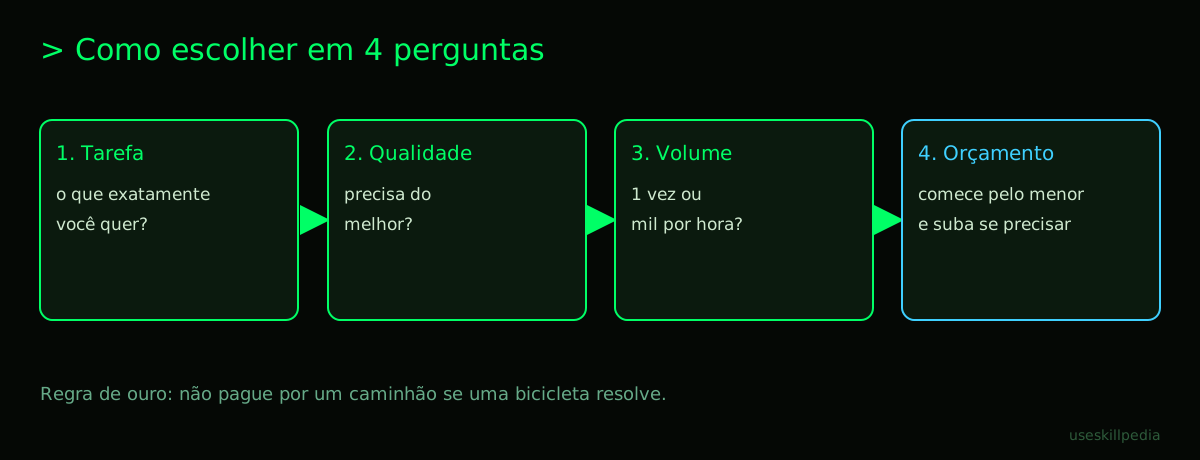
The rule is: don't pay for a truck if you only need a bicycle. Always start with the smaller, cheaper model. Only move up a level if the results aren't satisfactory. For a detailed analysis of the Claude family, see Which Claude model to use.
The open source and local world
Beyond the models from large companies, there is a vibrant universe of open source models. The big advantage here is freedom: you can run them on your own computer or server, without relying on an API, ensuring total privacy and control over operational costs.
Names like DeepSeek, Meta Muse Spark Open, and others mentioned earlier are great options for those with technical expertise who want independence. Performance, in many cases, rivals proprietary models for specific tasks.
If the privacy of your data or the cost of use at high scale is critical for you, it's worth exploring this route. Our article Best open source and local AI model gives you a starting point.
How to choose your model in 4 questions
Enough confusion. Next time you start a project, take a minute and answer:
- What is the EXACT task? (Write a book? Analyze 1000 PDFs? Answer support?)
- What complexity/quality is needed? (Does it need human-level creativity? Or just data extraction?)
- What is the volume? (Will I use it once a week or a thousand times an hour?)
- What is my budget? (Can I invest in the best or do I need the most economical option?)
The answers will naturally direct you to the right category (large, medium, small, or open source model).
How to test multiple models at once
You don't need to sign up for ten different services to compare. Tools like OpenRouter function as a "model aggregator." You access a single platform (or API) and choose from dozens of models from different companies, all with transparent prices.
Another way is to use apps that already offer this multi-choice. Claude Code, for example, allows you to configure which model to use for each project. Many modern code editors, like Cursor or VS Code with extensions, also give this flexibility.
Testing is essential. The model that works well for a colleague may not be ideal for your style or your specific task.
Important warning: everything changes very fast
The AI landscape in 2026 is dynamic. A model that leads a ranking this month can be surpassed next month. New models are launched, prices are adjusted, and benchmarks are updated.
That's why the most important thing is not to memorize who is the "champion" today, but to understand the selection process. Understand the difference between model types, learn to read price tables, and follow independent rankings. This way, you'll always be prepared to make the best decision, even if the names change.
We recommend testing these 3 skills first
Skills are instruction manuals for your AI agent, expanding what it can do. In Claude Code, they are super easy to add. Start with these three to see the power in practice:
- council-multi-model-affaan-m: This skill makes your agent automatically consult multiple AI models (like Opus, Sonnet, and Haiku) and give you the best consolidated answer. It's like having a committee of experts working for you.
- cost-aware-llm-pipeline-affaan-m: It automatically manages the cost of your AI queries. It starts using the cheapest model and only goes to a more expensive one if necessary, optimizing your budget without you having to think about it.
- prompt-optimizer-affaan-m: This skill helps improve the instructions you give the AI. It analyzes your prompt and suggests adjustments so you get more accurate and useful results, teaching you to communicate better with models.
To discover more amazing skills, explore the directory search skills and learn all about them in Claude Skill: what it is, how to install, and the best ones to test (2026 guide).
Frequently asked questions
Q: Can I use Claude Code on the free Claude plan? A: No. Claude Code is a tool for developers and is only included in paid Claude plans (Pro, Max, Team, and Enterprise). On the Free plan, you only have access to chat via the website or app.
Q: What is cheaper: using the API or subscribing to the Pro/Max plan? A: It depends on your usage. The Pro plan (US$20/month) is great for personal and moderate chat use. If you are a developer or company making thousands of API calls to automate processes, the API may be more cost-effective at volume. Do the math based on your estimated token consumption.
Q: Can a 1 million token model read my entire document? A: Probably, yes. 1 million tokens equals about 555 thousand words or 2.5 million characters. That's enough for entire books, large sets of code, or long meeting transcripts. Everything you send and receive counts toward that limit.
Q: Is Gemini Argon better than Claude Opus? A: "Better" is relative. Opus leads the overall intelligence ranking (Artificial Analysis). Argon leads the Vals Index (according to Google) and the "work value" category in professional tasks. The difference between them is small; the best is to test with your tasks. If you live in the Google ecosystem, Argon has the advantage of integration.
Q: Can I run models like GPT-6 or Claude Opus on my PC? A: No, these are huge models (called "frontier") that require a colossal server infrastructure with thousands of GPUs. You only access them via the internet (API). Smaller open source models, however, can be run locally on powerful hardware.
Q: What happens if I exceed the token limit in a conversation? A: It depends on the app. Some automatically summarize old parts, others warn that the conversation has reached the limit and ask you to start a new one. In any case, for very long conversations, it's worth summarizing what matters and continuing in a new conversation.
Q: Are Skills and Connectors (MCP) the same thing? A: No. Skills are instruction manuals that teach the AI how to do a task. Connectors is the name Claude.ai gives to MCP servers, which connect the AI to other apps and data. The two work together: the connector gives access, the skill teaches the way to do it.
Read also
- Best AI for Coding
- Best Free AIs
- Best open source and local AI model
- Best AI for Writing Texts
- Which Claude model to use
- What are tokens in AI (and why they run out so fast)
Sources
- Anthropic: model overview (accessed 10/16/2026)
- OpenAI models and pricing (accessed 10/16/2026)
- OpenAI: GPT-6.1 Sol (accessed 10/16/2026)
- Google: Gemini 4 Argon (accessed 10/16/2026)
- Gemini API pricing (accessed 10/16/2026)
- State of AI 2026 (rankings by area, 311 Institute) (accessed 10/16/2026)
- Claude plans and pricing (accessed 10/16/2026)
- Anthropic API pricing (accessed 10/16/2026)